An evolutionary model of antagonism

Antagonism

Antagonism represents a puzzling theme from an evolutionary perspective. Traits such as those associated with psychopathy impose an incredibly high cost on our species, despite their very low prevalence. Many scholars have suggested various hypotheses, almost always linking them to an individual advantage driven by aggressive and antisocial behaviors.

At the 65th edition of the Mind & Brain Congress, I presented an evolutionary model of antagonism. In this model, the starting point differs from the traditional individual-focused approach. While selection is almost always discussed in individual terms—from classical formulations to Dawkins’ famous selfish gene—alternative models have gained ground in recent decades. On one hand, there is a clear need to view selection in multilevel or hierarchical terms (genes, individuals, groups, species); on the other hand, culture and the social domain are increasingly understood in evolutionary terms, representing a sort of analog to the genome.

In this sense, an evolutionary model of antagonism can be explained by looking at the dynamics between groups and cultures within our species. In this presentation, I introduce the initial version of a model I am currently developing, starting precisely from the importance of considering the fitness landscape in multidimensional terms, and using this expanded perspective to understand personality traits in our species.

International Symposium on Evolution in Psychotherapy

Evolution in Psychotherapy

An international symposium on the evolution of psychotherapy promoted by the Ettore Majorana Foundation and the Center for Scientific Culture has recently concluded. I had the pleasure of being one of the invited speakers at the event chaired by Marco Del Giudice, which brought together researchers and clinicians from all over the world.

During the symposium, I gave a lecture on integrating interpersonal and evolutionary perspectives into psychotherapy. Particular attention was paid to how the evolution of our species requires a rethinking of how we typically think about the distinction between biology and culture.

In doing so, I have tried to present both a theoretical background and the possible applications of Evolutionary Systems Therapy and, in general, of an evolutionary and interpersonal perspective to psychotherapy.

The International Symposium on the Evolution of Psychotherapy was a fantastic opportunity to discuss the feasibility of this perspective with those presented by other participants.

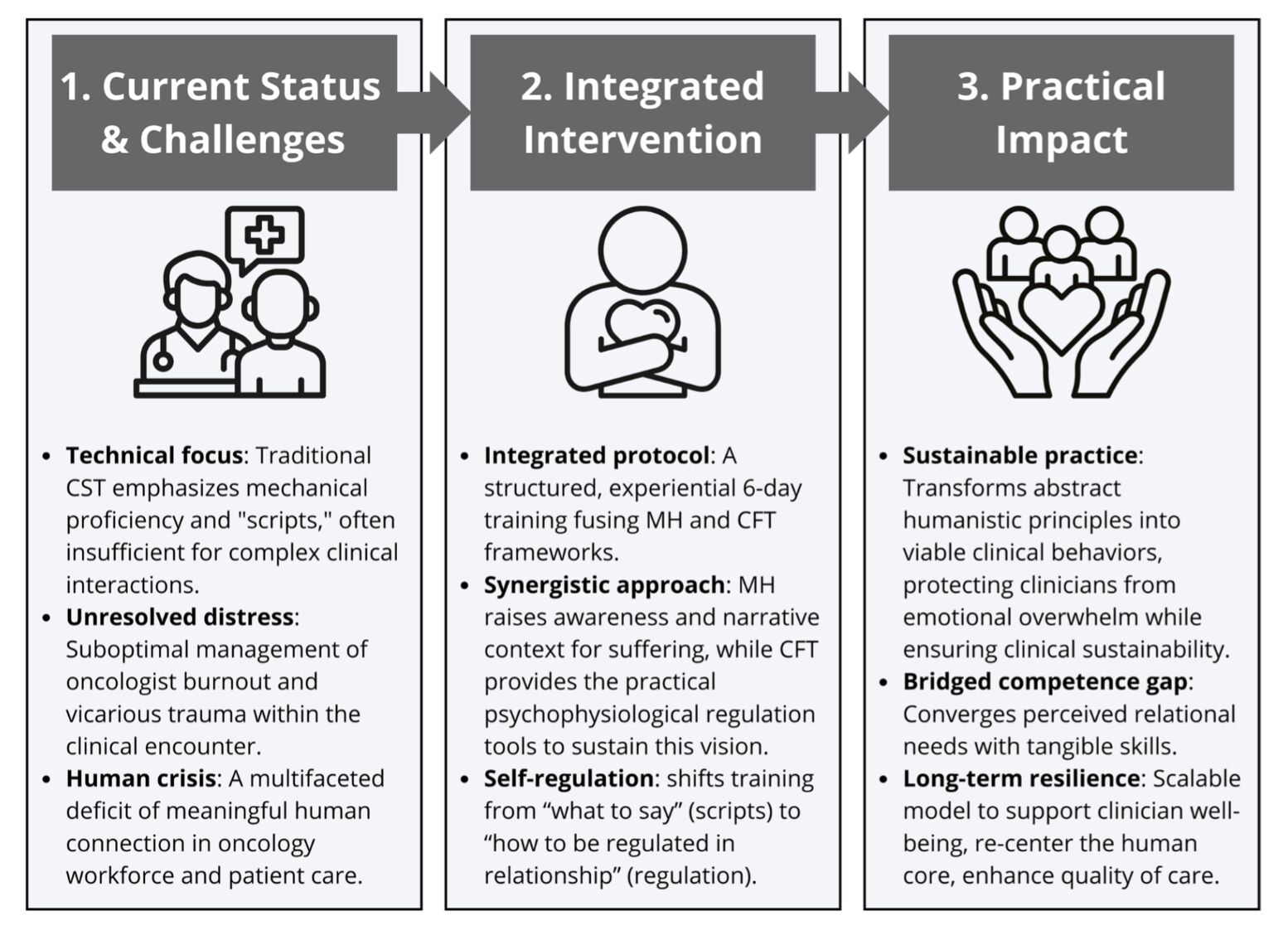
Addressing Burnout with the Mindful Compassion Care Program

I am proud to share that our pilot randomized controlled trial (RCT) has just been published. This study focuses on an intervention I conducted – together with Luca Bodini – with nurses in the COVID-19 wards at the University Hospital of Verona—the epicenter of the pandemic in Italy and, for a time, Europe.

I initially developed the Mindful Compassion Care Program (MCCP) in 2019, originating from my work with the University of Florence and the Oncology Department of Florence. Since its inception, the protocol has undergone a series of validation studies.

It began with a non-randomized trial on nursing students. It evolved through various case studies involving oncology nurses and physicians. Loredana Buonaccorso and her team are currently launching a confirmatory multicenter randomized controlled trial targeting healthcare professionals in oncology and palliative care.

MCCP integrates Mindfulness-Based Cognitive Therapy (MBCT) with Compassion Focused Therapy (CFT). The rationale behind the protocol is straightforward yet vital: burnout is not merely the result of exhaustion. It stems from an imbalance between the compassion shown to the patient and the compassion the healthcare professional directs toward themselves and receives from their team.

The new trial: https://doi.org/10.1177/13591053261433480

The original study: https://psycnet.apa.org/doi/10.1037/str0000126

Personality disorders and human evolution

personality disorders and human evolution

Personality disorders and human evolution is the focus of a new meta-synthesis we just published. The study presents a systematic review that integrates quantitative and qualitative methods to identify the most important insights from an evolutionary perspective on personality disorders.

Recent clinical evidence is beginning to confirm what many theorists have long suspected: an evolutionary lens provides indispensable tools for understanding personality disorders. A new integrative meta-synthesis of 50 key studies—spanning both quantitative data and qualitative narratives—has mapped the current state of this field.

The research identifies three primary “evolutionary models” that help clinicians move beyond mere symptom checklists:

  1. Evolutionary Mismatch: Traits that were once adaptive in ancestral environments but conflict with modern life.
  2. Emergency Mode: Personality patterns as “survival” strategies triggered by high-threat environments.
  3. Extremes of Variation: Disorders viewed as the statistical “tails” of normal, functional human diversity.

While the empirical data is still growing, this perspective offers a robust framework for clinicians to understand why these patterns exist, leading to more compassionate and effective therapeutic interventions. Among the studies, the model we are working on for the conceptualization and treatment of personality disorders also emerges.

Cheli, S., Bui, S., & Brüne, M. (2026). Personality Disorders and Human Evolution: An Integrative Meta-synthesis. Evolutionary Psychological Science (Online pubblication). https://doi.org/10.1007/s40806-026-00473-7

New Evidence for Evolutionary Systems Therapy

Evolutionary Systems Therapy, Evolution and Personality Lab

A paper has just been published reporting new evidence for Evolutionary Systems Therapy. The study was designed to extend what we already knew, investigating its feasibility and potential clinical utility.
Previously, an RCT and several case series had suggested the possible efficacy of Evolutionary Systems Therapy in the treatment of schizotypal traits. In this study, we compared its efficacy for other traits and the viability of the conceptualization model used.
Evolutionary Systems Therapy presupposes the existence of three interpersonal styles corresponding to the three major spectrums of psychopathology (defensive style corresponding to the spectrum of schizotypy or thought disorders; affiliative style corresponding to the internalizing spectrum; dismissing style corresponding to the externalizing spectrum). These three styles are not considered to be excluded from these spectrums but are instead identified during “difficult” times.
This new study reports new evidence for Evolutionary Systems Therapy. First, the correspondence between styles and their corresponding spectrums has been confirmed. Second, the efficacy previously demonstrated in the schizotypal spectrum was also confirmed in the other two spectrums.
Of interest was the fact that the target age was that of greatest risk for personality disorders: the 16-25 age group. This choice was intended to minimize the bias associated with the study’s small sample size and focus attention on those most at risk.

Cheli, S., Brüne, M., Goldzweig, G., Bui, S., Velicogna, F., & Cavalletti, V. (2026). Evolutionary systems therapy for personality pathology: a proof-of-concept single-arm trial. Current Psychology45, 375 (2026). https://doi.org/10.1007/s12144-025-08606-0 (Preprint and Supplementary Material are freely accessible at https://osf.io/urjdz/overview)

Are none, some, or all disorders interpersonal?

Simone Cheli

This paper follows my lecture, organized by the University of Montgomery. The starting question remains the same: Are none, some, or all disorders interpersonal?

The objective of this paper is to analyze three different hypotheses on the role of the interpersonal domain in psychopathology: specifically, whether none, some, or all disorders should be considered interpersonal. In evaluating these three theoretical positions, I present a general thesis and an antithesis for each, aiming to bolster an interpersonal perspective in psychotherapy. This perspective draws on principles formulated almost a century ago by Harry Stack Sullivan. Finally, I discuss an evolutionarily informed synthesis of all these theses and antitheses. My proposed conclusion is that the history of our species, general human functioning, and thus mental health and psychopathology, have always and distinctly evolved socially. Implications for conceptualization and treatment are discussed.

Cheli, S. (2025).Are none, some, or all disorders interpersonal? Ricerca Psicoanalitica36(3). https://doi.org/10.4081/rp.2025.1095

Are all disorders interpersonal?

cheli personality disorders

Today I spoke at the Workshop “Personality and Its Disturbances in Philosophy, Psychology, and Artificial Intelligence,” organized by the University of Montgomery. The presentation is part of the activities of the Evolution and Personality Lab.

The objective of the talk was to analyze three different hypotheses on the role of the interpersonal domain in psychopathology: specifically, whether none, some, or all disorders should be considered interpersonal. In evaluating these three theoretical positions, I present a general thesis and an antithesis for each, aiming to bolster an interpersonal perspective in psychotherapy. This perspective draws on principles formulated almost a century ago by Harry Stack Sullivan. The null hypothesis (“none” disorders) offers a critical analysis of modern psychopathology beginning with Freud; the quasi-interpersonal hypothesis (“some” disorders) focuses on Wright, Hopwood, and Pincus’s proposal to redefine personality disorders as interpersonal disorders; and the fully-interpersonal hypothesis (“all” disorders) reviews possible integrations between psychopathology and personality from an interpersonal perspective.

Finally, I discuss an evolutionarily-informed synthesis of all the proposed theses and antitheses. Drawing from models in evolutionary psychology and behavioral ecology—specifically the Social Brain Hypothesis, Life History Theory, and Tinbergen’s four questions—I attempt to motivate a radical interpretation of Sullivan’s thought.

My tentative conclusion is that the history of our species, human personality, and thus mental health and psychopathology, have always and distinctly evolved socially. Implications for conceptualizing and treating psychopathology are discussed.

An alternative view at needs and motivations

Yesterday I attended a symposium on needs, goals, and motivations. The introductory lecture was by Carol Dweck, followed by various perspectives based on Schema Therapy (e.g., Eskhol Rafaeli), CBT (e.g., Francesco Mancini), and Compassion Focused Therapy (e.g., Niki Petrocchi). I presented an alternative view of needs and motivations. My perspective was informed by evolutionary theory and aimed to offer a critical reading of these constructs. A special thanks to Maurizio Brasini who chaired the symposium and invited me.

In particular, I sought to emphasize two points. First, psychological constructs such as needs and motivations are created ex post to explain probabilistic processes such as natural and sexual selection. Defining general human functioning (e.g., personality) based on these low-order aspects risks making us forget a principle known since Gestaltpsychologie: the whole is not the sum of its parts.

Second, the phylogenetic trajectory of Homo sapiens is now primarily defined by cultural systems (which represent an analogue of genotypes), and many of the motivational models are almost exclusively consistent with Western cultural contexts—contexts where the individualistic, purposeful, and additive perspective on processes undoubtedly dominates.

This was an alternative view at needs and motivations of mine. A view rooted in an evolutionarily informed look at human personality.

The French philosopher François Julien, in discussing the effectiveness in East and West, cites two examples. On the one hand, Ulysses, who single-handedly resolved a decade-long war in one night. On the other, Sun Tzu, who saw the ideal of war as not taking the field. Perhaps what we think is certain is uncertain or undetermined.

For those interested, below is my presentation at the symposium:

Personality disorders and evolutionary psychopathology

Personality disorders and evolutionary psychopathology offers an intriguing perspective. Martin Brüne and I wrote a chapter on a new book published by Cambridge University Press.

“Personality” is considered as a set of individual characteristics and behavioral dispositions based on both temperamental (partially genetic-driven) and developmental (partially culture-driven) components that are relatively stable across time and context. We suggest that these two intertwined components progressively shape autopoietic processes operating at an individual and a social level in accordance with the theory of evolution and its application to human behavior. We discuss existing evidence linking personality traits to the manifestations of personality disorders and diverse forms of psychopathology. Particular attention is dedicated to the evolutionary concept referred to as Life History Theory, considering its utility in predicting the development of personality traits. We also emphasize the need to explore sources of critique and further research, suggesting that a multifaceted approach to the understanding of personality dimensions is crucial.

We hope this chapter may foster research on personality disorders and evolutionary psychopathology. For those interested in the topic here’s our Lab on personality and evolution!

Cheli, S., & Brüne, M. (2025). When Do Personality Traits Become Pathological?: An Epistemological and Evolutionary View. In K. Banicki & P. Zachar (Eds.), Conceptualizing Personality Disorder: Perspectives from Philosophy, Psychological Science, and Psychiatry (pp. 160–178). chapter, Cambridge: Cambridge University Press.

Personality and physical health

Personality and Health

Sara Bui and I wrote a chapter on personality and physical health for the new Palgrave Encyclopedia of Disability. In this chapter we explore the evidence about the relation between personality and physical health.

The existing approach in health highlights the importance of combining biological, psychological, and social factors to understand the mechanisms associated with the onset, adaptation, and outcomes of diseases. The area of research that has become increasingly important is the relationship between personality and physical health. Although the complexity of the interactions between the varied factors involved does not allow for conclusive answers, robust evidence confirms that personality plays a fundamental role along the entire continuum of health. In this entry we review the existing evidence, suggesting the importance of further research within a lifespan, dimensional, and evolutionary perspective on personality.

In the chapter we present an evolutionarily informed model of personality development to understand the responses and adjustment to illness and disability. This model is a revised version of the one developed by Martin Brüne and I on personality pathology.

This chapter is the second (I guess last) contribution Sara and I wrote for this interesting project.

Bui, S., Cheli, S. (2025). Personality in Physical Disability and Diseases. In: Bennett, G., Goodall, E. (eds) The Palgrave Encyclopedia of Disability. Palgrave Macmillan, Cham. https://doi.org/10.1007/978-3-031-40858-8_482-1